
Heirloom Tools
They are also the portfolio. Anyone can describe how they would build software; these are the actual artefacts, with their limits printed on them, and you can judge the work without talking to us.
All 10 Heirloom Tools
AI Opportunity Map
A guided diagnostic, free and complete in itself. You answer questions about how your work really runs — the repetitive parts, the parts that drain you, the parts you would never hand to a machine, and what you are actually standing on — and it returns your position on the eight-level sovereignty ladder, a ranked set of opportunities, a readiness reading, and the one next step worth taking.
- Time needed
- ~10 min
- Uses a language model
- Uses AI
- Personal data collected
- Your answers only
Crop Planner
For urban farmers, community gardens, beginning growers and backyard beds. Give it your space, your zone and what you want out of the season, and it lays out a working plan — bed allocation, a rough calendar, succession intervals and the questions to take to your local extension office.
- Time needed
- ~10 min
- Uses a language model
- No AI — fixed rules
- Personal data collected
- Your answers only
Land Access Navigator
Leasing, purchase, cooperative acquisition, community land trusts, municipal lots, church land, incubator farms, conservation programmes. This walks you through which pathways fit your situation and builds the paperwork you need before a conversation with a landowner — criteria profile, due-diligence checklist, questions to ask, outreach draft.
- Time needed
- ~12 min
- Uses a language model
- Uses AI
- Personal data collected
- Your answers only
Community Organizing Tool
Built for collective action: stakeholder and asset mapping, campaign planning, meeting agendas, volunteer role design, listening sessions, decision logs. It is designed for people organising with their neighbours, and it is deliberately not built for targeting individuals.
- Time needed
- ~12 min
- Uses a language model
- Uses AI
- Personal data collected
- Your answers only
Sovereign System Builder
The tool that carries the philosophy. It asks what you want to stop doing by hand, what knowledge must remain yours, what is sensitive, who needs access, and which decisions must stay human — then draws the system: human responsibilities, machine responsibilities, information flows, and what you must document so it outlives you.
- Time needed
- ~12 min
- Uses a language model
- Uses AI
- Personal data collected
- Your answers only
Time and Capacity Calculator
One task, examined properly. Tell it how long something takes, how repeatable it is, whether it is written down and what it touches, and it returns what that costs you in hours a year and how much could responsibly come back — as a range, never a single figure. Money is optional throughout.
- Time needed
- ~5 min
- Uses a language model
- No AI — fixed rules
- Personal data collected
- Your answers only
Rooted AI Workflow Builder
One recurring task, turned into a sequence you can hand to somebody. It maps what happens today, rates what the work touches, and returns a redesign where every step says who runs it — a person, an AI, or software running on its own. It will tell you to write the process down instead, when that is the honest answer.
- Time needed
- ~7 min
- Uses a language model
- No AI — fixed rules
- Personal data collected
- Your answers only
Heirloom Shield Scanner
One decision, answered by rules you can read. Describe the situation — never paste the material — and it returns green, amber or red, with the reason, what to remove, what stays with a person, and a safer way to get the same thing. Its companion, the Heirloom Shield self-assessment, reviews your whole practice; this answers a single question at the moment you are asking it.
- Time needed
- ~4 min
- Uses a language model
- No AI — fixed rules
- Personal data collected
- Your answers only
Heirloom Shield Self-Assessment
Human, Data, Cultural, Economic, Creative, Community and Ecological sovereignty. Answering honestly takes about fifteen minutes and produces strengths, vulnerabilities, the questions your team needs to sit down and discuss, and the areas where you need a professional rather than a framework.
- Time needed
- ~15 min
- Uses a language model
- No AI — fixed rules
- Personal data collected
- Your answers only
Community Resource Navigator
AI learning, Black and Indigenous technology organisations, farmer resources, grants, workforce programmes, cooperative economics and data sovereignty material. Every entry carries who verified it and when, because a directory without a date is a directory you cannot trust.
- Time needed
- ~3 min
- Uses a language model
- No AI — fixed rules
- Personal data collected
- Collects nothing
How this company builds, shown rather than claimed
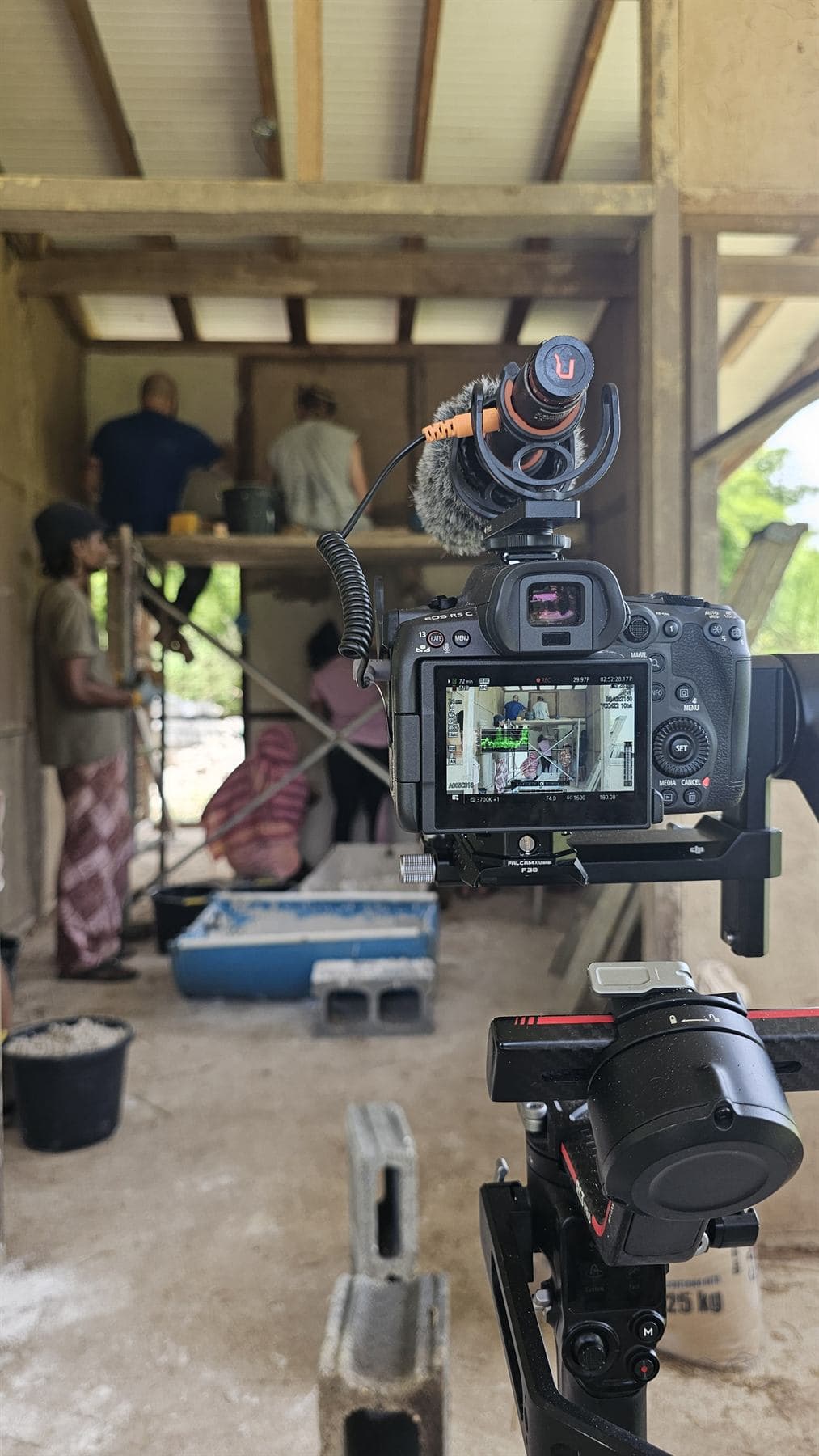
HP-A-019
Recording the plaster crew
Trinidad2025
Photograph · Photographer unrecorded
The deterministic result comes first
Every tool computes its answer in plain arithmetic before any model is consulted. If no AI provider is configured — or the call fails — you still get the whole result. The model is never load-bearing.
Every block declares where it came from
Source-backed, planning suggestion, AI-generated, or needs professional review. Nothing arrives unlabelled, so you always know which parts you can check and which parts you must.
Each one says what it cannot do
Printed on the tool before you start, not buried in terms. A tool that only lists its strengths is a brochure.
They end with what to take to a person
Every result closes with the questions no tool should answer — the ones that need a lawyer, an agronomist, your team or your elders.
And what they are all in service of
To help Afro-Indigenous communities build, power, govern, protect, repair, and economically benefit from local artificial intelligence systems aligned with land, culture, ecological responsibility, community ownership, and future generations.
Each tool ends by saying what its subject means for who owns the thing being built — the Crop Planner explains why it contains no AI at all, the Land Access Navigator names what should never go into a cloud tool, and the Opportunity Map places you on the eight-level sovereignty ladder.
The clearest evidence is the refusals
We publish 31 things our own research says not to build with AI — including that most community knowledge problems need file naming and search rather than a model, and that some knowledge should never be digitised at all.
6 of these never call a language model
The Crop Planner, the Heirloom Shield assessment and the Resource Navigator are pure arithmetic and curated data. They give the same answer every time, they cannot invent anything, and they work whether or not anyone has configured an AI provider. Where a tool does use a model, its card says so before you start.
What we do with your answers
Nothing, unless you ask. The tools run in your browser; where a model is involved, the request goes through our server carrying no identifying information and is not retained afterwards. If you want a copy of your result by email, you have to ask for it explicitly at the end — and that sends one email and adds you to nothing.
4 of the 10 tools use a language model for a written-guidance section that appears after your calculated results. That section is always labelled, and the results are complete without it.