Sovereign AI
Not that communities use AI. That they hold every power over it.
To help Afro-Indigenous communities build, power, govern, protect, repair, and economically benefit from local artificial intelligence systems aligned with land, culture, ecological responsibility, community ownership, and future generations.
Six verbs — build, power, govern, protect, repair, benefit. Adoption is not among them. This frames AI as an infrastructure question, closer to rural electrification or a community land trust than to buying a subscription: domains where Black and Indigenous communities were historically denied ownership even when they were granted service.
The test every decision is measured against
Does this choice increase the community's independent capacity, or does it recreate a new form of reliance on Heirloom Praxis itself?
A test worth stating is one an institution can fail. This one is designed so that our own commercial interest is the thing most likely to fail it.
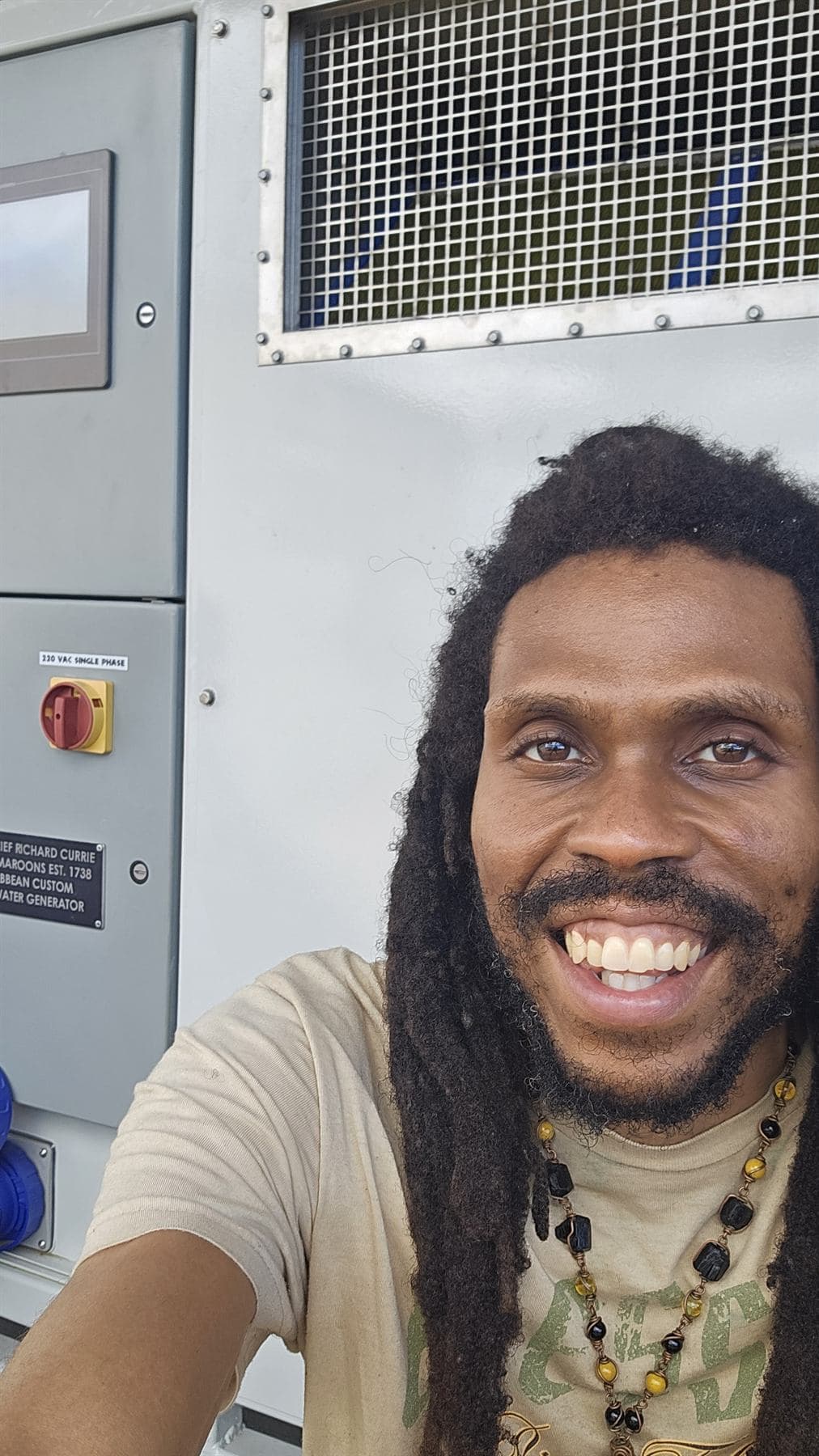
HP-A-024
Water from the air
Accompong, Jamaica2026
Photograph · Photographer unrecorded
What off-grid AI actually means
Artificial intelligence architected to do meaningful work without continuous dependence on centralised electrical utilities, public internet, or corporate cloud platforms. It is not an offline mode bolted onto a cloud product: independence from outside infrastructure is a design requirement, not a fallback.
A system that is technically offline but controlled by an absentee funder or a single technologist is not liberated. Ownership and succession are as central as wattage and quantisation.
Three sovereignties, or none
These are inseparable. A system holding two of the three is a dependency with better marketing.
Energy sovereignty
If the grid goes down, does it still run?
Solar, battery and load management sized so the system survives an outage rather than ending with one. This is the sovereignty most often skipped, because it is the one that costs money up front.
Data sovereignty
Who holds what it knows?
Control over what is collected, stored, shared and trained on. A local model answering questions about your own records is a different relationship to knowledge than a chatbot that has read them on someone else's server.
Governance sovereignty
Who can switch it off?
The community — not a vendor, not a funder, not the consultant who installed it — decides use, access and shutdown authority. Succession is part of the design, not an afterthought.
Eight levels, from a subscription to infrastructure you own
| Level | What it can do | What it needs | Cost | Who governs it |
|---|---|---|---|---|
| 0Cloud dependent | Full-featured, but only while the internet and the vendor hold | Internet plus a subscription | Recurring, unbounded | The vendor's terms of service |
| 1Offline reference library | Static documents, searchable, no AI | A device and storage | $50–$300 | A simple custodian |
| 2Single-device offline AI | Local chat and retrieval over your own documents, on one machine | Mini PC or laptop, plus a quantised model | $600–$1,500 | Individual or family |
| 3Shared local network | A multi-user hub with shared files, no public internet needed | Hub, router, client devices | $1,500–$4,000 | A small team or board |
| 4Renewable-powered community node | Solar and battery independence, sensors, runs through an outage | Solar array, battery bank, hub | $4,000–$12,000 | Formal community governance |
| 5Distributed cooperative network | Multiple sites syncing, shared training, repair capacity | Several nodes plus a sync layer | $15,000–$50,000+ | A cooperative council |
| 6Regional sovereign infrastructure | Repair centres, regional communications, collective procurement | Multiple Level 4–5 nodes plus a backbone | $50,000–$250,000+ | A regional governance council |
| 7Global diaspora intelligence commons | International exchange and knowledge reciprocity | Cross-border legal, cultural and technical coordination | Highly variable | Federated, jurisdiction-aware governance |
Governance first, technology second
Each level's path to the next requires building the next level's governance capacity BEFORE its technology. A household at Level 2 should not attempt Level 5 networking without first developing cooperative decision-making experience at Levels 3 and 4.
The smallest system that genuinely counts
A solar-charged mini PC or laptop running a quantised local model with an offline knowledge library — a Level 2–3 node that does real work today while being architected to federate into a regional network later.
A federation of named institutions, not a market of segments.
A working farm
Growing operation with beds, controlled-environment rooms, and produce moving to CSA members, markets and pantries.
Anything installed has to survive a season of weather, dirt and interruption while the people running it are already doing another job. Cold chain is physics and paper fallback is not a downgrade.
Off-Grid AI for Food Distribution, Farmers Markets, CSA, Food Pantries, Cold Chains, and Community Logistics
A community building
An intergenerational site holding a resource desk, a library, food distribution, meetings and a public kiosk.
It serves people who arrive without a smartphone, without broadband at home, and sometimes without wanting to be registered at all. Every function needs a printed and a telephone path, permanently rather than as an accommodation.
Elders, Care Networks, Intergenerational Knowledge, Aging in Community, and Off-Grid AI
A land cooperative
Several independently governed farms and parcels that share standards, equipment and sometimes data.
Federation, not merger. Each site stays sovereign, which means synchronisation is selective and governed, and a shared map of holdings is itself a disclosure risk before it is an asset.
Offline GIS, Land Mapping, Farm Planning, Watershed Intelligence, and Afro-Indigenous Geospatial Sovereignty
A Black church
A congregation running visits, meals, transport, phone trees and emergency coordination through relationships that already exist.
Pastoral information is not a database. Care cannot be conditioned on membership, and the trust that makes the network work is exactly what a badly governed record system spends.
Elders, Care Networks, Intergenerational Knowledge, Aging in Community, and Off-Grid AI
A media and technical arm
The group doing recording, restoration, transcription, accessibility conversion and archival organisation.
It must not become the default owner of community memory. Source files stay separate from transcripts and AI-generated metadata, and a do-not-train field applies to source media by default.
Offline Educational Libraries, Community Knowledge Commons, Local AI Tutors, and Sovereign Learning Infrastructure for Afro-Indigenous Communities
Diaspora partners
Institutions in Zanzibar, Cuba and the wider Caribbean working on the same problems under different law and infrastructure.
No kit exports. Salt air, sanctions, import permits, blackout-prone grids and separate jurisdictions mean the engineering and the governance both have to be redone locally, and permanently installed hardware becomes locally owned.
Comparative Diaspora Off-Grid AI Strategy: New Haven, Zanzibar, Cuba, Africa, and the Caribbean
Field note
Not a new idea being introduced. An old practice being resumed.
Meroe, Kingdom of Kush
Iron furnaces running above 1,200°C, inside a state, a trade network and specialised labour guilds.
Industrial capacity has always come bundled with the institutions that govern it.
Timbuktu
Hundreds of thousands of manuscripts on law, medicine and astronomy, held through family custodianship.
Distributed custody outlasts central collection. It is also harder to seize.
The Carolina Lowcountry
Tidewater rice engineering — canals, dikes, sluices, reservoirs — carried from West Africa by enslaved people, then credited to planters.
Technical authorship gets reassigned. Recording who built a thing is part of building it.
Maroon societies, Jamaica and Suriname
Redundant low-infrastructure relay networks of drums, horns and runners, with mobile settlements designed against detection.
Resilience through layering and deliberate illegibility, not through a single best channel.
Mound Bayou and Nicodemus
Self-governed hospitals, newspapers, credit unions and schools built under scarcity and hostility.
Institutions first. The infrastructure follows the governance, not the other way round.
George Washington Carver
Refused exclusive patent control over his agricultural work.
Anti-extraction licensing has a lineage here. It is not a modern software idea.
Design principles drawn from them
- Appropriate scale
- Redundancy
- Distributed, apprenticeship-based knowledge transmission
- Selective secrecy
- Community ownership of infrastructure
- Ecological fit
- Resistance to extraction
Two narratives our research rejects
- That African and Indigenous peoples were passive recipients of technology.
- That ancestral tools or cosmologies were secretly literal computers or AI systems.
The second one matters here. Flattering mystification is the easiest thing for a brand like this to reach for, and it is still a way of not taking the actual history seriously.
31 things our research says not to build
Knowledge systems
Most community knowledge problems do not need AI at all.
Sacred and sensitive material
Some knowledge should never be digitised at all.
Controlled-environment agriculture
Humidity, temperature, CO₂, lighting and irrigation timing are thermostat problems, not machine-learning problems.
Aquaponics
Demonstration scale only, with redundant battery-backed aeration.
The rule underneath the list
Build the smallest system that creates real value, document it, maintain it, evaluate it, and expand only when people, money, governance, repair capacity, and operating discipline exist to support the next level.
The lines that stop this becoming another dependency
An institution selling liberation infrastructure is perfectly capable of becoming the thing it warns about. These four exist because that failure is the likely one, not the unlikely one.
- 01
Community data ownership
The community owns its data. Not licensed to us, not shared back to us, not ours to train on.
- 02
Anti-extraction licensing
What we build is licensed so it cannot be turned against the people who paid for it, and so it survives us.
- 03
No dependency-trapping subscriptions
Support is a service you may buy. It is never the thing that keeps your system working — a system that stops when the invoice stops was never yours.
- 04
Cultural review protocols
Anything touching sacred, spiritual or culturally specific material requires documented community consent and named review by qualified community stewards — not generic diversity review.
Through people, on a ladder with the same names as the brand
- 01
Seed
First contact. What these systems are, and what they are not.
- 02
Root
Operating and maintaining a node under supervision.
- 03
Trunk
Installing, configuring and securing systems independently.
- 04
Canopy
Designing systems, training others, governing deployments.
- 05
Forest
Setting standards, leading research, holding policy positions.
A language model or a farm dashboard is only as sovereign as the watt-hour that powers it.
This site is a Level 0 system
This website is a Level 0 system. It runs on commercial cloud hosting, its optional AI features call commercial model APIs, and if those vendors disappeared it would go with them. It is a doorway to the work, not an example of it. The tools on it are deliberately built to keep working without any model at all, which is the only part of it that points at Level 2.
Every interface choice, colour palette, sound design, data policy and piece of copy already encodes a worldview. The question is not whether cosmology shapes technology, but whose cosmology, under what authority, and with what epistemic honesty.
The standard this page is most at risk of failing
Cultural aesthetics — visual branding referencing African or Indigenous symbolism — must never substitute for actual community ownership, consent, or revenue-sharing. The standard exists specifically to prevent extractive practices from hiding behind culturally resonant design.
That is written about projects, and it applies to this website. The palette, the motifs and the typography here are not ownership, consent or revenue-sharing, and they must never be allowed to read as though they were.
Sourced from
- Off-Grid AI Liberation Systems: A Complete Taxonomy and Reference Architecture
- Heirloom Praxis: An Afro-Indigenous Off-Grid AI Training, Research, Installation, and Systems-Integration Company
- Root Life Off-Grid AI Master Implementation Roadmap: From First Pilot to Sovereign Regional Infrastructure
- The Global State of Off-Grid AI for Black and Afro-Indigenous Communities
- African and Afro-Indigenous Histories of Technological Sovereignty: A Historical Foundation for Off-Grid AI
- Afro-Indigenous Data Sovereignty, Community AI Governance, and Collective Digital Rights: A Root Life Policy Framework
- Offline Community Knowledge Bases and Local RAG Systems for Afro-Indigenous Liberation
- Off-Grid AI Hardware: Computers, Servers, Accelerators, Storage, and Repairability
- Renewable Energy, Battery Storage, and Microgrid Design for Off-Grid AI
- Community Mesh Networks, LoRa, Radio, and Resilient Off-Grid Communication: A Root Life Systems Design Manual
- Cybersecurity, Physical Security, and Threat Modeling for Community-Controlled Off-Grid AI
- Off-Grid AI for Microgreens, Mushrooms, Aquaponics, Hydroponics, and Controlled-Environment Agriculture
- Off-Grid AI Youth Apprenticeship, Certification, Career, and Cooperative Ownership System
- Cooperative Economics, Capital Formation, and Shared Ownership for Off-Grid AI
- Legal, Regulatory, Contractual, and Compliance Framework for Off-Grid AI Infrastructure
- Off-Grid AI for Black and Afro-Indigenous Health, Healing, Wellness Literacy, and Community Care
- Afro-Indigenous Spirituality, Cosmology, Sacred Design, Energy Language, and Scientific Integrity in Off-Grid AI
- Comparative Diaspora Off-Grid AI Strategy: New Haven, Zanzibar, Cuba, Africa, and the Caribbean
- Water Sovereignty, Off-Grid Water Systems, Irrigation Intelligence, Quality Monitoring, and Community Governance
- Community-Owned Environmental Sensing, Pollution Monitoring, Ecological Intelligence, and Data Justice
- Local Weather Intelligence, Climate Adaptation, Farm Forecasting, and Offline AI for Black Land Resilience
- Drones, Ethical Remote Sensing, Aerial Mapping, and Community-Controlled Field Intelligence
- Low-Power Robotics, Appropriate Automation, and Human-Controlled Machines for Off-Grid Farms and Community Infrastructure
- Black-Owned Microgrids, Community Energy Cooperatives, and Energy Sovereignty for Off-Grid AI
- Community-Owned Internet, Local Intranets, Digital Commons, and Sovereign Community Network Infrastructure
- Offline Educational Libraries, Community Knowledge Commons, Local AI Tutors, and Sovereign Learning Infrastructure for Afro-Indigenous Communities
- African, Afro-Diasporic, Indigenous, Creole, and Community Language Technology for Offline AI Sovereignty
- Elders, Care Networks, Intergenerational Knowledge, Aging in Community, and Off-Grid AI
- Disability Access, Universal Design, and Accessible Off-Grid AI for Community Sovereignty
- Off-Grid AI for Disaster Preparedness, Climate Emergencies, Mutual Aid, and Community Continuity
- Off-Grid AI for Food Distribution, Farmers Markets, CSA, Food Pantries, Cold Chains, and Community Logistics
- Offline GIS, Land Mapping, Farm Planning, Watershed Intelligence, and Afro-Indigenous Geospatial Sovereignty
- Root Life Value-Added Manufacturing Roadmap: Commercial Kitchens, Freeze Drying, Herbal Products and Off-Grid Food Systems
- Afro-Indigenous Homeschooling, Freedom Schools, Mobile Education, Land-Based Learning, and Off-Grid AI
- Afro-Indigenous Seed Sovereignty, Genetic Preservation, Community Seed Banks, and Offline AI for Crop Memory
- Reproductive Justice, Body Sovereignty, Sexual Health Literacy, Intimate Data, and Off-Grid AI
- Community Safety Without Police Surveillance: A Non-Carceral Framework for Root Life, 333 Valley, Native Praxis, and Partner Institutions
Internal research and design documents. They are the reason this page can be specific about costs, levels and governance rather than gesturing at sovereignty as a mood.